
1. Overview
The Politburo’s Resolution No.15-NQ/TW on the directions and tasks to develop the capital of Hanoi in the period 2001-2010 clearly states: “Hanoi is the heart of Vietnam, the national political and administrative centre, the hub of culture, science, education, economy and international relations”. For its geo-economic and political significance, Hanoi shows a great development potential and is regarded as a promising dynamic destination offering plenty of opportunities for both domestic and foreign investors.
Over the past 20 years, Foreign Direct Investment (FDI) in Hanoi has recorded enormous encouraging achievements, making fundamental changes in the city’s socio-economic life as well as promoting its intensive and extensive international integration. FDI has also contributed significantly to the State budget and creating jobs for the city’s residents. Yet, a number of problems have also emerged in FDI attraction and realization, particularly the risk of unbalanced economic development; overloaded infrastructure; environmental pollution; unhealthy competition and business; conflicts between employers and employees...
In such a context, opinions differ on the roles and impacts of FDI on Hanoi’s development. Some say that FDI has played an important role in the city’s socio-economic achievements while others discreetly attribute FDI to the above-mentioned problems. Hence, there have arisen two questions: what are the roles and impacts of FDI on the development of Hanoi in the past two decades?; and what policies should be introduced to promote FDI positive effects and minimize its negative ones in the coming time? The two questions are the subject matter that will be addressed in this paper.
2. FDI contribution to the development of Hanoi since the introduction of the renovation policy
2.1. Total registered and realised FDI capital, the number of FDI projects
In the period 1989-2009, Hanoi attracted approximately 1,890 FDI projects with the total registered FDI capital of nearly USD 20 billion and the estimated realised capital of over USD 7 billion, accounting for 37.5% of the registered total. The process of foreign capital attraction from 1989 to date can be divided into four distinct periods as follows:
· The period 1989 – 1992: In this period, domestic and foreign investors undertook initial study, developed mutual understanding for future cooperation. Hanoi attracted only 51 projects with USD770 million worth of registered capital, and only 12% of the total registered FDI was realised, averaging USD 24 million/year.
· The period 1993 – 1996: This period was marked with a sharp increase in both the scale and pace of FDI investment. The registered capital reached its peak of USD 2,641 million in 1996, 2.5 times higher than that in 1995. Similarly, the realised capital increased rapidly and steadily with one-year time lag. Three contributing factors for Hanoi’s booming FDI were the removal of the US trade embargo on Vietnam in 1994, Vietnam’s full ASEAN membership in July, 1995 and Vietnam’s amended Law on Foreign Investment (LFI) in 1996.
· The period 1997 – 2004: This period was characterised by the Asian financial crisis and its aftermaths. FDI in Hanoi plummeted at an average of 62% in 1997-2000 and fluctuated around USD 100-300 million in 2001-2004. Falling FDI was due to not only the regional crisis but also Vietnam’s unattractive policies on foreign investment despite certain amendments to the LFI in 1996. Realised FDI in this period peaked at USD 712 million in 1997, and then fell sharply in the wake of the regional crisis, and just increased slightly at the end of the period. The signing of the Bilateral Trade Agreement (BTA) between Vietnam and the US in 2001 exerted great impact on increasing both registered and realised capital at the end of the period.
· The period 2005 – 2009. This period witnessed quite complex development of the world economy. A number of favourable regional and global changes together with steadily improved domestic investment environment as a result of more liberal investment registration procedures following the promulgation of the Law on Investment and Law on Enterprises applicable to both foreign and domestic investment.
The Law on Investment 2005 was in accordance with the World Trade Organisation (WTO) principles and practices, creating dual effects on FDI attraction. Vietnam’s WTO membership in 2007 also laid the foundation for first the resurgence of FDI in Hanoi. The year 2005 was a milestone of Hanoi’s first-time leading in attracting FDI, amounting to USD 1,585 million (Figure 1).
In 2008, the registered FDI reached a record high of USD 5,091 million, of which USD 1,456 million was realised. In 2009, given the negative impacts of the global crisis, Hanoi, like many other cities and provinces, saw a sharp decrease in the amount of projects, committed and realised capital (Figure 1).
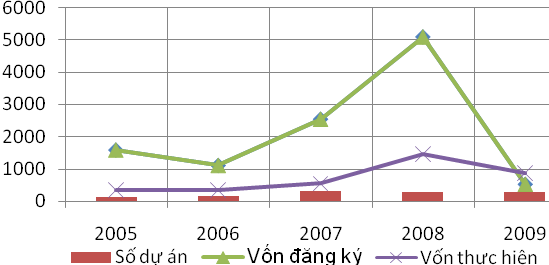 |
Figure 1 |
Figure 1: The amount of projects, registered FDI and realised FDI in Hanoi, 2005-2009
Source: Hanoi Department of Planning and Investment , 2010
· The year 2010 is of great significance to the capital – 1000th Great Anniversary of Thang Long – Hanoi. In the first 8 months of 2010, Hanoi attracted 170 new projects with the total registered capital (of both existing and newly-invested projects) of approximately USD 177 billion, accounting for nearly 26% of the projects and 22% of the total registered capital of the whole country. In the present context of volatile world finance, complex and unpredictable economic downturn, such efforts deserve high recognition.
2.2. Contribution to total social investment
In the period 1989-1998, realised FDI started to grow and held an increasing proportion in the total social investment in Hanoi. In 1996-1998, realised FDI became an important channel to attract investment, occupying an overwhelming proportion of over 50% in Hanoi’s total social investment.
From 1999 to 2003, due to the Asian financial crisis, the realised FDI hit the bottom, accounting for only 7.2% of the total social investment. Since 2005, the realised FDI stablised at 12-14% of the total social investment, about (Figure 2).
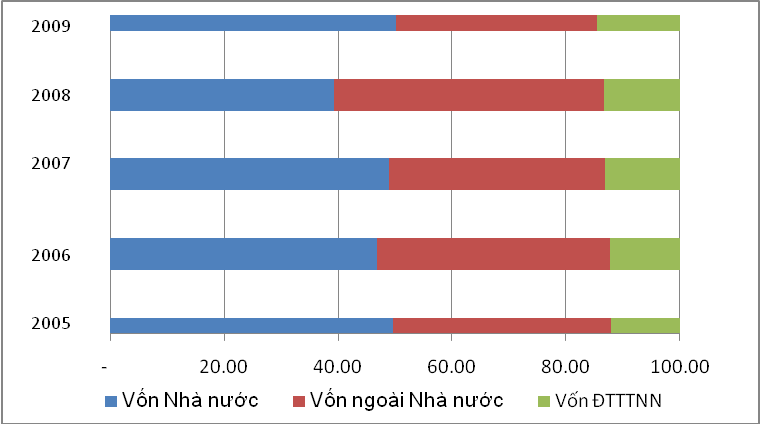 |
Figure 2: Structure of social investment in Hanoi in terms of ownership, 2005-2009
It is estimated that in 2010 foreign enterprises contribute about 15% to the total social investment. This results from the effective enforcement of the Law on Enterprises and Hanoi’s efforts to develop favourable mechanisms, policies and a legal corridor for FDI realisation. Despite its strong fluctuations during the period, FDI is still an important channel of Hanoi’s investment attraction.
2.3. Contribution to GDP growth and the State budget
FDI plays an important part in the GDP growth of Hanoi. Foreign-invested enterprises made up 13.9%, 15%, 15.6% of GDP in 2000, 2005 and 2006 respectively. In 2009 – 2010, they accounted for roughly 16% of the city’s annual GDP on average.
Another important role of FDI in the socio-economic development of Hanoi is increasing revenues of the State budget through taxes. The proportion of foreign-invested sector in budget revenues showed an increasing tendency in the period 2005 – 2009, despite a slight decline in 2009 due to the global crisis (Figure 3). The rise apparently results from Vietnam’s accession to the World Trade Organisation (WTO), which has increased foreign capital flow into Vietnam, and significantly improved the investment environment of Hanoi since the introduction of the Law on Investment in 2005.
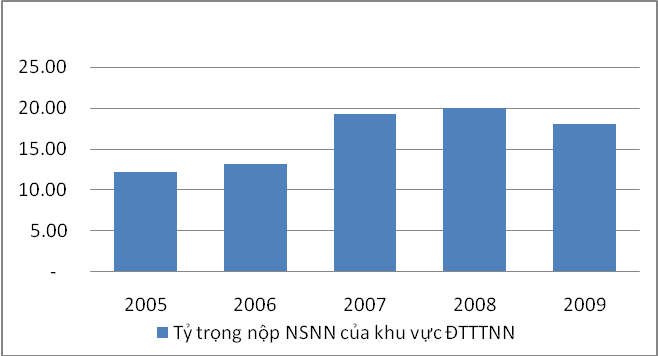 |
Figure 3: Proportion of budget revenues contributed by FDI enterprises
Source: Hanoi Department Planning and Investment, 2010
2.4. Contribution to export
FDI enterprises have enhanced the quality, efficiency and competitiveness of exported goods in certain fields, and thus accelerating the city’s export revenues. From 1989 to 2007, the export revenues of the foreign-invested sector were estimated to be nearly USD 6 billion. The annual export growth of the sector in the period 2001-2005 averaged 49% compared to the overall average of 17% and 9% the period 1996-2000. The proportion of the foreign-invested sector in the total export revenues rose from 13% (2000) to 31.8% (2005), 37.5% (2006) and 38.8% (2007).
The major exports of the foreign-invested sector include electrical systems, automobiles, camera components, soft wares, flat colour TVs, motorbikes, digital components.... FDI enterprises generally find outlets for their products and avoid competing with traditional products of Vietnam, helping increase the quantity and quality of the city’s exported goods, mainly modern hi-tech products.
2.5. Technology transfer
85% of FDI enterprises in Hanoi employ modern technology and 78% of them are equipped with new facilities. In recent years, major partners of Hanoi include France, Britain, Germany, Canada, Italia, Japan, Singapore, South Korea and Hong Kong – hi-tech countries with many corporations of high technological and financial competitiveness. Cooperating with foreign partners, Hanoi has access to advanced technology and techniques in key industries such as telecommunication, electronics, automobiles, chemical engineering, international hotel construction, production of consumer goods, and food processing. Some technologies in telecommunication, electronics, hotel and hospitality have been on a par with the regional and international standards.
Significant influence of technology transfer on Hanoi’s economy is overwhelming as the relatively high ratio of joint-ventures to the total number of FDI enterprises in the city, about 47% in the period 2005-2009. Besides, given the advantage of high-quality labour force, the influence of technology transfer is more significant in enhancing managerial capacity and skills of the labourers through various skill improvement activities and training courses for the staff working in foreign-invested enterprises in as well as the labour force shifting from FDI enterprises to other sectors. This workforce would continue sharing their knowledge and experiences working in FDI enterprises with domestic counterparts.
2.6. Job and income generation
FDI projects generated approximately 62,000 jobs in 2005 and the number steadily increased by 2007. In 2008 and 2009, due to the global crisis, the workforce in the FDI sector was downsized yet remained high at about 80,000 employees (Figure 4).
A recent survey conducted by Vietnam Towers Watson in 154 Vietnam-based FDI enterprises has shown that Hanoi is one of the two cities with the highest income in the country.
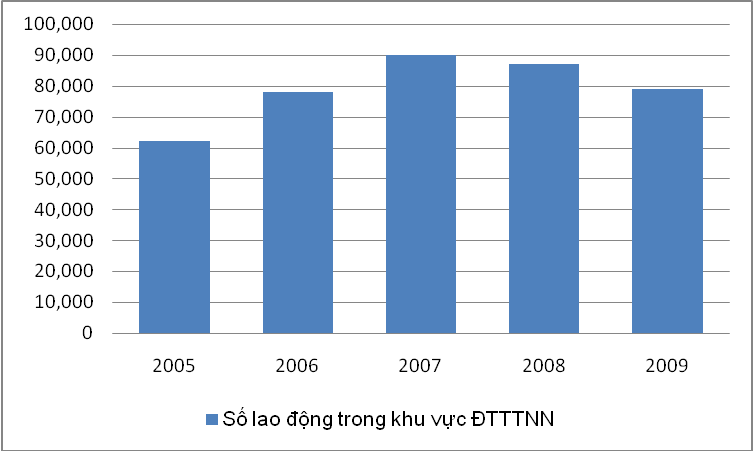 |
Figure 4: The number of employees in FDI sector in Hanoi
Source: Department of Planning and Investment, 2010
Therefore, FDI in Hanoi has contributed significantly to creating jobs and raising income.
2.7. Other contributions
2.7.1. Promoting the city’s economic structure shift
FDI projects in Hanoi mainly concentrate on service and industry sectors, thus exerting tremendous impact on the city’s shift to a modern economic structure. In the period 2005 – 2009, FDI in the service sector held the highest proportion (56.5% of the projects and 55% of the registered capital), followed by that in the industry sector (39.3% of the projects and 40% of the registered capital). The development is appropriate and well reflects the industrialization promotion policy of the Party and Government as well as Hanoi city municipal government.
2.7.2. Promoting integration into the world economy
So far, over 40 nations and territories have invested in Hanoi. Current FDI in Hanoi mostly is made by trans-national corporations and companies with global affiliation. Hanoi, therefore, enjoys advantages of accessing and penetrating the global market, expanding export market, familiarising itself with international practices, adapting to the ever-changing global market, promoting its integration into the world economy, especially with ASEAN member countries like Singapore, Thailand, Malaysia, Indonesia and the Philippines, East Asian countries like Japan, South Korea, and Hong Kong, as well as European countries and other superpowers like the United States, Canada, and Australia. Undeniably, close cooperation with other countries in investment is as important as beneficial in changing Hanoi’s outlook, fostering the city’s international economic relations as well as enhancing its status in the world arena.
2.7.3. Upgrading infrastructure
In recent years, foreign companies, in cooperation with competent and prestigious enterprises in Hanoi, have invested in the city’s key projects, contributing to building the infrastructure and image of a modern civilised city. More urban and residential quarters such as Thang Long International Village, Ciputra, My Dinh, which are characterised by uniformity, modernity, have been developed to adopt a civilised urban lifestyle.
3. FDI negative impacts on the development of Hanoi.
Despite its positive contribution to Hanoi’s development, FDI also has three following negative aspects: the risk of unbalanced development, unhealthy competition environment and environmental pollution.
3.1. Unbalanced economic development
As one of the leading economic centres of Vietnam, Hanoi always especially attends to balanced economic development with its advantages. In reality, the current FDI in Hanoi is posing a risk of an unbalanced economic structure. Hanoi has introduced incentives to encourage investment in agriculture – forestry – fishery, especially since the city’s territorial expansion. Yet, as this sector has a low rate of returns on investment and slow turnover, the number of projects in this sector remains modest. The number of projects, registered capital and realised capital in agriculture makes up only 3% of the total FDI commitment and 6% of the total realised FDI of Hanoi from 1989 to 2007. Foreign projects mainly focus on building factories to process some farm and sea products and wooden crafts. Very few FDI projects are involved in marine husbandry and cultivation. Consequently, despite the city’s relatively modern industrial and service sectors, the agricultural sector remains backward, unproductive. This is a potential risk that could result in Hanoi’s unbalanced development. Also, unbalanced sectoral investment might widen the social class distinction, particularly income disparity.
3.2. Unhealthy competition and business
Real estate investment in Hanoi is currently viewed as one of the great potentials by foreign investors. In 1988 – 2007, the number of FDI projects on the construction and real estate sector in Hanoi accounted for 44% of the total number of projects, 33% of the total committed capital and 17% of the realised FDI in Hanoi. Such projects concentrate on constructing hotels, office towers, trade centres, industrial zones and new urban quarters.
Increasing FDI in the construction and real estate sector is well-matched with Hanoi’s development, helping the city upgrade and develop its infrastructure. Still, such investment involves potential risks of long-term and medium-term macro-economic instability, specifically low job generation, low real value creation compared with industrial, construction and agricultural projects, limited added value, no high technology transfer, and extensive land occupation resulting in numerous wastelands.
Construction and real estate usually involve big capital-intensive projects for the high costs of site clearance and favourable location. When delayed, these projects might not only ruin the city’s scenery but also hinder many other potential domestic investors, causing unhealthy competition and business in the market. Some industrial zones such as Sai Dong A have their licenses revoked due to slow progress in land confiscation and site clearance. This leads to a big waste of resources, while farmers have no land to cultivate. Consequently, the inhabitants’ livelihood is adversely affected.
Besides, due to low commitment of foreign investors, a variety of projects have been suspended, negatively affecting the city’s scenery and the capital’s master development plan. Lotus Hotel project worth of USD 500 million is one such case. The project was suspended in August, 2009 due to capital shortage although Japan’s River Corporation had committed to complete the project by the end of 2009. More seriously, many FDI real estate projects mobilise quite a lot of domestic capital. Hence, when such projects fail to implement, other domestic real estate investors are badly affected. As a result, foreign investors obtain the capital that should have been granted to domestic investors.
3.3. Environmental pollution
Another negative impact of FDI is environmental pollution. One of causes is that FDI enterprises do not strictly abide by the Law on Environmental Protection. Many enterprises do not install waste treatment systems or use such systems as a camouflage.
Another pollution risk involves FDI investment in golf courses, causing not only soil pollution but also air and water pollution, badly affecting inhabitants’ health and agriculture development. In the past, 10 big golf courses were planned to be constructed in Hanoi, including Tuan Chau eco-tourism resort (Ha Tay), Me Linh golf urban area, Dong Suong Lake golf course, Cam Quy Lake golf course, Phu Man golf course and eco-tourism resort, Me Tri resort and sports centre, Long Bien golf course and eco-tourism resort, Chuong My Temple Lake Golf course & resort, Thanh Tri 36-hole golf course, and Meo Gu Lake international golf course. These golf courses were planned to be constructed in rice-growing land or residential areas, seriously affecting agricultural development, the environment and the residents’ health and livelihood. A number of demonstrations have been staged by farmers to protest against golf course construction, which is supposed to create the so-called ‘unhealthy social psychology’ as such luxury facilities are constructed for the upper class in the neighbourhood of poor farmers. For such reasons, the construction of 10 golf courses have been cancelled. 9 existing courses in Hanoi and their impacts on the environment would be properly evaluated to phase out the negative ones.
3.4. Conflict of interests between employers and employees
Apart from positive aspects of FDI such as job creation, labour quality improvement, employer-employee relationship is currently a matter of public concern. In certain cases, foreign investors tend to maximise their profits and do not properly obey the Labour Code, triggering public outcries, undermining social security and the image of FDI enterprises.
Intense employer-employee relationship mostly involves working conditions and environment, working time and salary. In April, 2010, 1,000 workers of Vietnam Young Past Company, Ltd (Thach That Industrial Zone, Quoc Oai, Hanoi) went on strike to protest the company’s violation in staff recruitment. Another strike was held on 5th and 6th May, 2010 by more than 800 workers of Katolec, an enterprise majoring in electronics microchips in Quang Minh Industrial Zone (Me Linh, Hanoi), to demand a pay rise by VND 500,000 (approx. USD 26) and paid leave. Conflict of interests between Vietnamese workers and foreign investors is no longer simply an economic matter but rather a socio-political one, leaving a bad impression on the labour and investment environment in Vietnam in general and in Hanoi in particular.
4. Recommendations for improving positive roles of foreign investment in Hanoi’s development
First, it is necessary to have a long-term vision to introduce policy on FDI attraction and realisation in Hanoi. The vision should take into account various factors such as post-crisis global context, new status of FDI in Hanoi’s economy, sectoral development priorities, and complementary policies on FDI attraction. Specifically, the policy on FDI attraction and realisation must be closely associated with ‘Hanoi Capital Socio-economic Development Strategy to 2030 with a vision to 2050” and “Hanoi Capital Master Socio-economic Development Plan to 2020 with a vision to 2030.”
Second, a master plan for FDI realisation in Hanoi must be developed. Based on Hanoi’s Master Planning, it is important to seek the locations and prepare new project portfolios to call for investment, make a priority list of projects in order to provide foreign investors with more useful information to facilitate their investment decision-making.
Third, transparent mechanisms and policies on incentives for foreign investors should be introduced to eliminate discrimination against foreign investors, encouraging FDI contribution to the city’s socio-economic development, thus increasing FDI attraction and taking full advantage of FDI. For example, it is essential to loosen regulations on land lease duration, forms of land use, adopt appropriate incentive policies to attract FDI in Hanoi, propose incentive mechanisms to attract investment in hi-tech projects to promote technology transfer, to introduce specific regulations on requirements of technology transfer in FDI projects and mechanism to encourage foreign investors to transfer modern technology to Hanoi.
Fourth, it is necessary to adopt transparent mechanisms and policies to counter the negative effects of FDI, specifically accomplishing mechanisms and policies to encourage FDI in agriculture, introducing specific regulations on technology transfer in FDI projects to prevent intermediary transfer, transfer of outdated costly environment-unfriendly technology, better attending to environmental criteria in project evaluation and approval, constructing golf courses in accordance with the city’s master planning, clearly identifying the rights and obligations of employees in foreign-invested enterprises.
Fifth, professional solutions must be sought to boost the efficiency of FDI attraction and realisation, such as training and developing high-quality labour force; developing strategy for building adequate infrastructure and rapidly developing services for investors, promoting foreign investment, making annual plans for foreign investment promotion in different economic sectors, localities, with specific partners and markets.
Conclusion
In the past 20 years, FDI has proved its essential roles in socio-economic development of Hanoi in different aspects: promoting socio-economic growth, shifting to a positive and modern economic structure, generating employment and raising income for the capital’s residents, improving technology transfer, and increasing export revenues. Yet, FDI has also exerted some negative impacts, such as potential risks of unbalanced economic development, unhealthy business and competition, especially in the real estate and construction sectors, environmental pollution, and conflict of interests between employers and employees. FDI positive impacts would be maintained and promoted while the negative ones would be minimized if the municipal government develops a long-term comprehensive plan for FDI attraction and realisation on the basis of the city’s long-term master planning. Besides, Hanoi should develop transparent incentive mechanisms and policies for foreign investors, introduce regulations on technology transfer, assess environmental criteria of FDI projects, work out professional solutions, such as human resource development, infrastructure development and FDI promotion. Given that, the Hanoi would make breakthrough in its development to become a modern city corresponding to its significant economic and political status as a capital of 1000-year culture.
REFERENCES
1. Phung, X.N. (2010). Điều chỉnh chính sách Đầu tư trực tiếp nước ngoài ở Việt Nam trong tiến trình Hội nhập kinh tế quốc tế.[Adjusting Vietnam’s FDI policies in the process of world economy integration ].Hanoi: VNU Publication.
2. Hanoi People’s Committee. (2008). Báo cáo tổng kết 20 năm (1987-2007) hoạt động đầu tư trực tiếp nước ngoài trên địa bàn Hà Nội. [Report on FDI in Hanoi in 20 years (1987-2007)]. Hanoi: Hanoi’s People’s Committee.
3. Hanoi People’s Committee. (2009a). Báo cáo về thực hiện nhiệm vụ kinh tế - xã hội, an ninh quốc phòng năm 2007 và kế hoạch phát triển kinh tế - xã hội, an ninh quốc phòng năm 2008 của thành phố Hà Nội. [Report on achievements in socio-economic development, national defense and public security in 2007 and plan on socio-economic development and national defense and public security in 2008 of Hanoi]. Hanoi: Hanoi People’s Committee.
4. Hanoi People’s Committee. (2009b). Báo cáo về thực hiện nhiệm vụ kinh tế - xã hội, an ninh quốc phòng năm 2009 và kế hoạch phát triển kinh tế - xã hội, an ninh quốc phòng năm 2010 của thành phố Hà Nội. [Report on achievenments in socio-economy, national defense and public security in 2009 and Plan on development of socio-economy and national defense and public security in 2010 of Hanoi]. Hanoi: Hanoi People’s Committee.
Rector of University of Economics and Business, VNU
Lecturer of Faculty of International Economics and Business, University of Economics and Business, VNU
. Hanoi People’s Committee. (2008). Báo cáo tổng kết 20 năm (1987-2007) hoạt động đầu tư trực tiếp nước ngoài trên địa bàn Hà Nội. [Report on 20 years (1987-2007) of FDI in Hanoi].
Department of Foreign Investment, Ministry of Planning and Investment. 2010. Report on FDI January- August, 2010.
. Hanoi’s People’s Committee. (2008). Báo cáo tổng kết 20 năm (1987-2007) hoạt động đầu tư trực tiếp nước ngoài trên địa bàn Hà Nội. [Report on Hanoi FDI Hanoi in 20 years (1987-2007)].
Nguyen, T.A. (2008). 400 ha Sài Đồng A Industrial Zone becoming parks and urban areas [Electronic Version]. Vietnamnet, 21/7/2008. http://vietnamnet.vn/kinhte/2008/07/794636/.
Hoàng Lan. 2010. Hanoi’s Proposal to Cancel 10 Golf Course Projects: http://w14.vnexpress.net/GL/Kinh-doanh/Bat-Dong-san/2009/08/3BA124E2/


